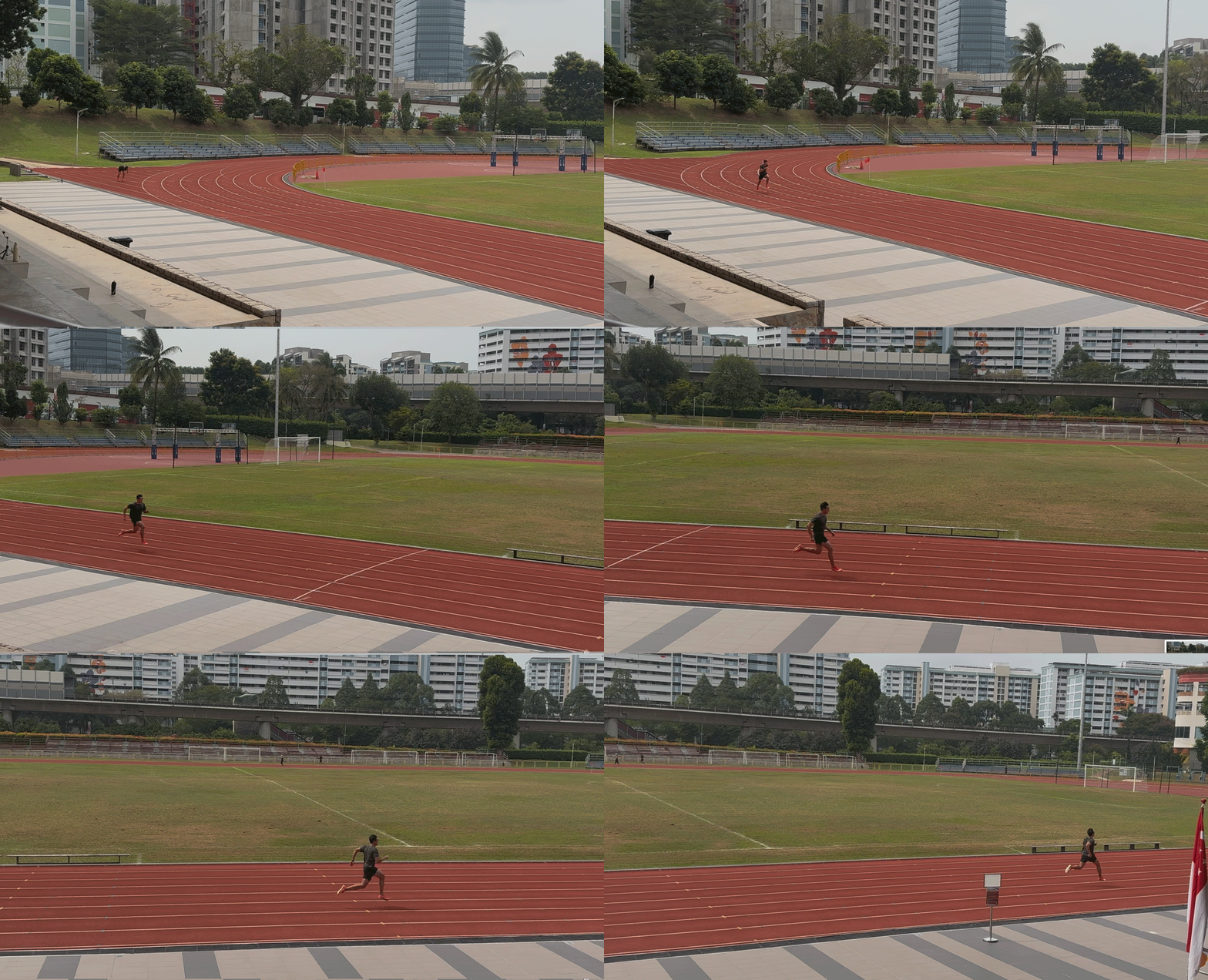
August has been a crazy month to watch track. The Julien Alfred and Melissa Jefferson-Wooden rivalry hit its peak, each championing different races, four days apart, each one won by a hair.
Silesia went to Melissa Jefferson-Wooden. She led from the gun, with Julien Alfred closing hard, with the final result of 10.78 to 10.83. Then Zurich, into a headwind, and Alfred got it back by five thousandths of a second: 10.693 to 10.698, a Saint Lucian record, too close to call without the photo. Sha'Carri Richardson was third on both nights.
The men weren't quiet either. Oblique Seville took Silesia in a meet-record 9.83 with Kenny Bednarek right behind in 9.87, and four days later Bednarek came back over 200m in Zurich to run 19.62 for the world lead.
And not forgetting Zurich's hurdles night where Alison dos Santos took down Warholm's 400m hurdles world record in 45.80, and Masai Russell broke the 100m hurdles world record in 12.09! Two world records at the same meeting!
Watch any of those races back, and no two athletes run the same way. Different builds, different rhythms, visibly different strides.
In my last post I argued that the "stride rate vs stride length, which is king?" debate is a false choice, and that the answer depends on the athlete. Let's take a look at what makes them move.
Two numbers that barely change
Sprint speed is stride length × stride rate. Everyone knows that. What most people miss is that the stride is built from three time periods, and two of them are nearly identical in every runner alive.
Peter Weyand tested 33 runners whose top speeds ranged from 6.2 to 11.1 m/s, and what he found was surprising
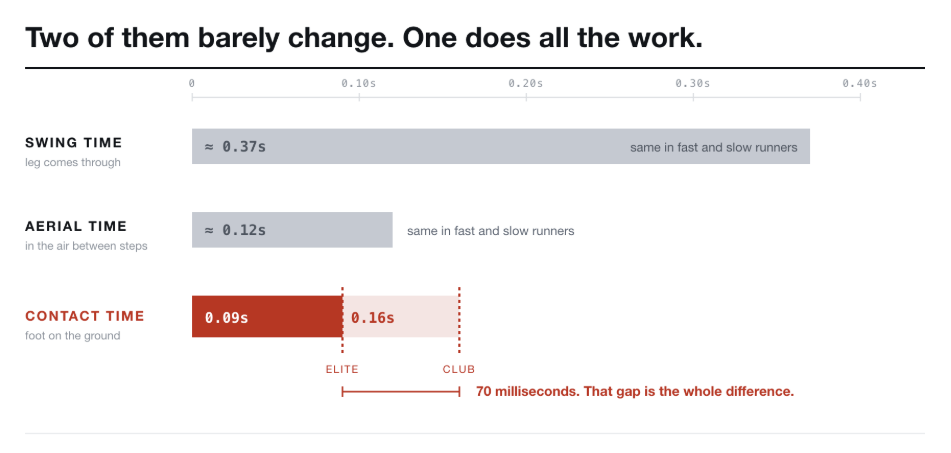
Swing time (how long it takes to bring the leg through for the next step): no meaningful difference between fast and slow runners. Everyone sits around one third of a second.
Aerial time (how long you're in the air between steps): also similar across the board, typically around 0.12 seconds at top speed.
That leaves exactly one time period that actually varies: ground contact time.
Elite sprinters are on the ground for roughly 0.09–0.11 seconds at top speed. A club athlete might be at 0.14–0.16. That gap is the entire difference. Not leg speed or Air time. Contact.
What this means for stride rate
Your stride cycle is simply contact time plus swing time. If swing time is fixed at about a third of a second, then the only way to take more strides per second is to spend less time on the ground.
That's it. That's the whole mechanism.
So "work on your turnover" is bad advice, because leg speed isn't the variable. The variable is how quickly you get off the ground, which is a reactive strength quality. In a study of 24 elite U21 athletes, those with higher reactive strength scores had significantly shorter ground contact times when sprinting and were faster over 20–30m, without losing any stride length. That last part matters. It's a frequency gain without losing length.
What this means for stride length
Your stride is how far you travel while your foot is down, plus how far you travel while you're in the air. If aerial time is roughly fixed at 0.12s, then flight distance is basically just your speed × 0.12.
Which means stride length isn't something you set. It's a readout of how fast you're already going.
Fast runners have long strides because they're fast, not the other way around. Weyand's conclusion was blunt: what separates human top speeds is how hard you can hit the ground relative to your own bodyweight. Everything else follows from that.
The complication
Try to push harder deliberately and here's what your body actually does: it stays down and drives through the hip and ankle. Contact time goes up. You also float longer, because you've put more into the ground vertically.
Your stride gets longer. Your stride rate drops on both counts, longer on the ground and longer in the air. And you land harder, which means more braking to absorb on the next step. In one study of 50m sprints, more vertical force through the middle phase was associated with getting slower, not faster. When researchers modelled the pure version of this, extra float, contact held constant, stride length went up, stride rate went down, and speed barely moved at all.
There's a second version of the same trap: reaching. Stretching the leg out to cover more ground lands your foot too far in front of your hip, and the ground pushes you backwards on contact. Your step length measurement goes up. Your time goes up too.
So what actually matters
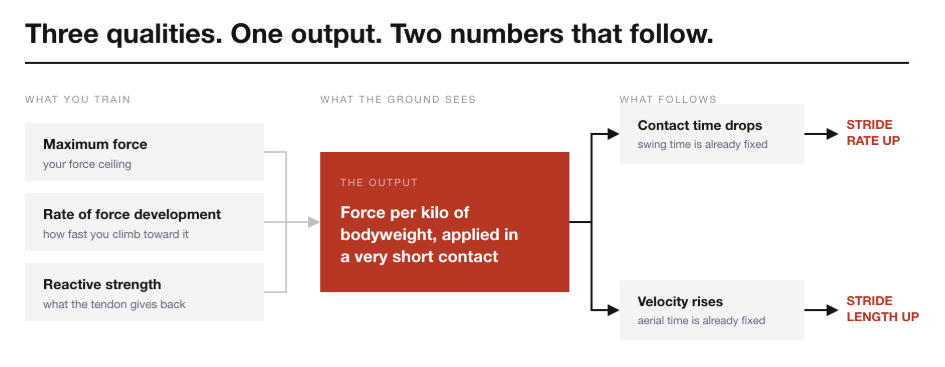
Both stride rate and stride length are downstream of one thing the ground actually sees: how much force you apply per kilo of bodyweight during a very short contact.
But that single output is fed by three separate trainable inputs — maximum force (the ceiling), rate of force development (how fast you climb toward it), reactive strength (how much the tendon contributes under stretch). Weak in any one and the number the ground sees goes down.
Sources: Weyand et al., J Appl Physiol 2000 and 2010; Hunter, Marshall & McNair, Med Sci Sports Exerc 2004; Nagahara et al., Int J Sports Med 2018; reactive strength and sprint acceleration, Applied Sciences 2025; strength and sprint ground reaction forces, PLOS One 2025.
How ATHLETIC INC can help:
We measure before we prescribe. Force plate testing gives us your reactive strength profile, your contact times, your rate of force development, and any left-right imbalance. That tells us whether your limitation is force capacity, reactive ability, or mechanics.
We train all three qualities. Whether its Maximum strength, Rate of force development or reactive strength, we got you covered.
Every level, same process. We work with national-level athletes, recreational sprinters, and general population clients. The testing is the same. The prescription isn't.
At ATHLETIC INC, we merge proven methodologies with modern technology to deliver data-driven insights that drive results.
Whether you're aiming for elite performance or mastering your favourite sport, achieve your peak through our integrated approach to strength, recovery, and nutrition. Speak to our experts today.
MEET THE AUTHOR

MING WONG
Strength & Conditioning, & Performance Coach
SPECIALISATIONS
Athletics
Running & Sprinting
Sports Massage
High Performance Training
Strength & Conditioning